
The Confounding Case of
Jean-Claude Carré

In late 1921, outside of Boston, Massachusetts, a set of weathered notes were found, hand-written by the British reporter Leslie Pickering, and describing a series of extraordinary events. In this account, what began as a newspaper story covering a French dance troupe grew in complexity to involve eldritch forces beyond the pale of human experience and sanity. Fortunately, this reporter was joined by a company of rather unlikely investigators including an institutionalised detective, a delusional boy genius, their athletic and compassionate caretaker, along with a preternaturally good pastry chef, a Flemish Count, and his stately butler.

This map of Old Boston from the 1920s was annotated by the editor, the academic researcher Dr. Jones, to indicate key locations appearing in the narrative of Leslie Pickering.

Who was Schopenhauer, the man who is quoted continuously by Jaeger Gundheim? Arthur Schopenhauer was a 19th-century German philosopher and influential thinker whose brilliant insight always seemed to be tinged with melancholy. He is perhaps best known for his ideas on how our sense of reality is shaped by perception and human will. How do you discern what is real in the world, and what evidence do you require?


Was the H6 real? John Harrison's H5 certainly was, and the accounting of its history in Leslie Pickering's notes is largely accurate. The H5, built in 1770, is generally accepted as the final product of his remarkable campaign to develop maritime chronometry. The H6 and Elias Dougal Duran's phase chronostat exist only in this narrative, though H6 is referenced in modern efforts to advance atomic clocks. What other elements in this narrative are historical truth and what are alternate history at best, or misinformation at worst? What evidence would you seek to tell the difference? Photo from the Science Museum (London), Creative Commons.

Are the spells captured in Leslie Pickering's notes real? All words carry a form of magic, with power over the world of mind and emotion, if not the physical world itself. Can you decode the various human languages drawn upon within the spellcraft recorded in this journal?
Who is Dr. Jones, the enigmatic researcher who uncovered the notes of the reporter Leslie Pickering? In truth, Brent Jones is a physicist working in Albuquerque, New Mexico. By day, he pursues plasma physics and high-energy-density science. By night, he codes, writes, draws, paints, and enjoys long walks on the beach. The Confounding Case builds on a family RPG story and includes a few of his kids' characters. He has also published the full-color adventures of Captain Blackthorn documenting family play with a popular interlocking brick system.
The Key of the Golden Cat returns in the card game Mythos: Lock & Key, available at DriveThruCards.com.


T-shirts are available through Etsy!

COMING SOON--Are you frustrated with the state of American politics? Me too. This manifesto proposes a way to push our country back to the middle, to seek compromise on policy, and to bolster democracy. For ages 15+.

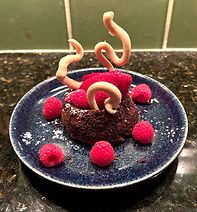
Amongst the reporter's notes, several recipes were found scrawled on loose scraps of paper or upon parchment folios provided by the exceptional pastry chef Nousha Baxter. Shown here is Cthugha's Favorite Chocolate Lava Cake, which received rave reviews when prepared by Dr. Jones for his family from the recipe reprinted in the book.
.png)
Was Belle da Costa Greene a real librarian? Yes, she was the personal librarian to financier J. P. Morgan and noted for her dynamism and style. Her relationship to the truth was complex, and the reader is invited to research her history. How many librarians, dancers, scientists, or other historical figures are mentioned in the manuscript?

